Saturday, May 14, 2011

ATOMIC STRUCTURE

Atoms are made up of 3 types of particles electrons , protons  and neutrons .  These particles have different properties.  Electrons are tiny, very light particles that have a negative electrical charge (-). Protons are much larger and heavier than electrons and have the opposite charge, protons have a positive charge.  Neutrons are large and heavy like protons, however neutrons have no electrical charge.  Each atom is made up of a combination of these particles.

  Let's look at one type of atom:
     

The atom above, made up of one proton and one electron, is called hydrogen (the abbreviation for hydrogen is H).  The proton and electron stay together because just like two magnets, the opposite electrical charges attract each other.  What keeps the two from crashing into each other?  The particles in an atom are not still.  The electron is constantly spinning around the center of the atom (called the nucleus).  The centrigugal force of the spinning electron keeps the two particles from coming into contact with each other much as the earth's rotation keeps it from plunging into the sun.  Taking this into consideration, an atom of hydrogen would look like this:
A Hydrogen Atom
Keep in mind that atoms are extremely small.  One hydrogen atom, for example, is approximately 5 x 10⁻⁸ mm in diameter.  To put that in perspective, this dash - is approximately 1 mm in length, therefore it would take almost 20 million hydrogen atoms to make a line as long as the dash.  In the sub-atomic world, things often behave a bit strangely.  First of all, the electron actually spins very far from the nucleus.  If we were to draw the hydrogen atom above to scale, so that the proton were the size depicted above, the electron would actually be spinning approximately 0.5 km (or about a quarter of a mile) away from the nucleus.  In other words, if the proton was the size depicted above, the whole atom would be about the size of Giants Stadium.  Another peculiarity of this tiny world is the particles themselves.  Protons and neutrons behave like small particles, sort of like tiny billiard balls.  The electron however, has some of the properties of a wave.  In other words, the electron is more similar to a beam of light than it is to a billiard ball.  Thus to represent it as a small particle spinning around a nucleus is slightly misleading.  In actuality, the electron is a wave that surrounds the nucleus of an atom like a cloud.  While this is difficult to imagine, the figure below may help you picture what this might look like:
Hydrogen: a proton surrounded by an electron cloud
While you should keep in mind that electrons actually form clouds around their nucleii, we will continue to represent the electron as a spinning particle to keep things simple.

        In an electrically neutral atom, the positively charged protons are always balanced by an equal number of negatively charged electrons.  As we have seen, hydrogen is the simplest atom with only one proton and one electron.  Helium is the 2nd simplest atom.  It has two protons in its nucleus and two electrons spinning around the nucleus.  With helium though, we have to introduce another particle.  Because the 2 protons in the nucleus have the same charge on them, they would tend to repel each other, and the nucleus would fall apart. 


EXAMPLE How many electrons, protons, and neutrons are there in each of the atoms represented below?


{}_{\text{6}}^{\text{12}}\text{C}      {}_{\text{20}}^{\text{40}}\text{Ca}      {}_{\text{82}}^{\text{206}}\text{Pb}      {}_{\text{20}}^{\text{40}}\text{Ca}^{\text{2+}}

Solution For an atom the number of electrons equals the number of protons and is given by Z. For an ion the atomic number gives the number of protons, but the number of electrons must be determined from the charge. Thus


{}_{\text{6}}^{\text{12}}\text{C} contains 6 electrons and 6 protons.


{}_{\text{20}}^{\text{40}}\text{Ca} contains 20 electrons and 20 protons.


{}_{\text{82}}^{\text{206}}\text{Pb} contains 82 electrons and 82 protons.


{}_{\text{20}}^{\text{40}}\text{Ca}^{\text{2+}} has lost two electrons. Therefore it contains 18 electrons and 20 protons.

The number of neutrons can be obtained by subtracting the number of protons (Z) from the total number of particles in the nucleus (A):


{}_{\text{6}}^{\text{12}}\text{C}      N = A – Z = 12 – 6 = 6 neutrons


{}_{\text{20}}^{\text{40}}\text{Ca}      N = 40 20 = 20 neutrons (The same applies to {}_{\text{20}}^{\text{40}}\text{Ca}^{\text{2+}}. Only electrons are gained or lost when an ion forms.)


{}_{\text{82}}^{\text{206}}\text{Pb}      N = 206 82 = 124 neutrons

To keep the nucleus from pushing apart, helium has two neutrons in its nucleus.  Neutrons have no electrical charge on them and act as a sort of nuclear glue, holding the protons, and thus the nucleus, together.

A Helium Atom
        As you can see, helium is larger than hydrogen.  As you add electrons, protons and neutrons, the size of the atom increases.  We can measure an atom's size in two ways: using the atomic number (Z) or using the atomic mass (A, also known as the mass number).  The atomic number describes the number of protons in an atom.  For hydrogen the atomic number, Z, is equal to 1.  For helium Z = 2.  Since the number of protons equals the number of electrons in the neutral atom, Z also tells you the number of electrons in the atom.  The atomic mass tells you the number of protons plus neutrons in an atom.  Therefore, the atomic mass, A, of hydrogen is 1.  For helium A = 4. Ions and Isotopes
       
So far we have only talked about electrically neutral atoms, atoms with no positive or negative charge on them.  Atoms, however, can have electrical charges.  Some atoms can either gain or lose electrons (the number of protons never changes in an atom).

If an atom gains electrons, the atom becomes negatively charged.  If the atom loses electrons, the atom becomes positively charged (because the number of positively charged protons will exceed the number of electrons).  An atom that carries an electrical charge is called an ion.  Listed below are three forms of hydrogen; 2 ions and the electrically neutral form.

           H+ : a positively charged hydrogen ion

  H : the hydrogen atom

  H- : a negatively charged hydrogen ion


Neither the number of protons nor neutrons changes in any of these ions, therefore both the atomic number and the atomic mass remain the same.  While the number of protons for a given atom never changes, the number of neutrons can change.  Two atoms with different numbers of neutrons are called isotopes.  For example, an isotope of hydrogen exists in which the atom contains 1 neutron (commonly called deuterium).  Since the atomic mass is the number of protons plus neutrons, two isotopes of an element will have different atomic masses (however the atomic number, Z, will remain the same).

Two isotopes of hydrogen


Hydrogen
Atomic Mass = 1.0
Atomic Number = 1.0


Deuterium 
Atomic Mass = 2.0 
Atomic Number = 1.0

Say that an element is made up of 20% Deuterium and 80% Hydrogen. What is tha average mass? 

(0.20 x 2) + (0.80 x1) =  1.2 g/mol


Sunday, April 10, 2011

Lab 6D : Determining the Limiting Reactant and Percent Yield in a Precipation Reaction

Remember the Lab we did way back when?

I'll just give a quick review of it.

Our object was to observe the reactions and determine the limiting and the excess reactants. Then find out the percent yield by comparing the actual mass with theoretical mass.

This lab took us two classes because we had to create precipitate solution and then filter the precipitate separate from the solution.

We had to calculate the masses of filter paper, dried filter paper with the precipitate and the dried precipitate.

There were few sources of error: Not having the exact required amounts of solution and the uncertainty of the centigram which we used to calculate the masses.

In conclusion, we proved that percent yield is true and that it wasn't 100% because not all reactants react completely because of the wrong conditions.

Percent Purity

Fun break first!!


 Many samples of chemicals are not pure. We can define percent purity as

mass of pure compound in the impure sample     x 100%
total mass of impure sample             


If an impure sample of a chemical of known percent purity is used in a chemical reaction, the percent purity has to be used in stoichiometric calculations. Conversely, the percent purity of an impure sample of a chemical of unknown percent purity can be determined by reaction with a pure compound as in an acid-base titration. Percent purity can also be determined, in theory, by measuring the amount of product obtained from a reaction. This latter approach, however, assumes a 100% yield of the product.

Examples

Consider the reaction of magnesium hydroxide with phosphoric acid.

3Mg(OH)2  +  2H3PO4 ---->   Mg3(PO4)2 + 6H2O

(a) Calculate the mass of Mg3(PO4)2 that will be formed (assuming a 100% yield) from the reaction of 15.0 g of 92.5% Mg(OH)2 with an excess of H3PO4
mass Mg(OH)2 = 15.0 x 0.925 = 13.875 g
mass Mg3(PO4)2 =

13.875 g Mg(OH)21 mol Mg(OH)2  x  1 mol Mg3(PO4)2  x  262.9 g Mg3(PO4)2
                         58.3 g Mg(OH)2       3 mol Mg(OH)2        1 mol Mg3(PO4)2

20.9 g Mg3(PO4)2


(b) Calculate the mass of 88.5% Mg(OH)2 needed to make 127 g of Mg3(PO4)2, assuming a 100% yield.
 mass Mg(OH)2 =

127 g Mg3(PO4)2 x  1 mol Mg3(PO4)2  x  3 mol Mg(OH)2  x  58.3 g Mg(OH)2
                        262.9 g Mg3(PO4)2   1 mol Mg3(PO4)2  1 mol Mg(OH)2


= 84.49 g Mg(OH)2.

mass 88.5% Mg(OH)2  =

84.49 g Mg(OH)2   x  100 g 88.5% Mg(OH)2  = 95.5 g
                                       88.5 g Mg(OH)2

(c) Calculate the percent purity of a sample of Mg(OH)2 if titration of 2.568 g of the sample required 38.45 mL of 0.6695 M H3PO4. 
mass Mg(OH)2 =

38.45 mL H3PO4 x  0.6695 mole H3PO4  x  3 moles Mg(OH)2
                                   1000 mL H3PO4            2 moles H3PO4
                                x     58.3 g Mg(OH)2
                                      1 mole Mg(OH)2

= 2.251 g Mg(OH)2

Percent Purity = 2.251   x  100% =  87.7%
                        2.568


Wednesday, April 6, 2011

Percent Yield

Why there is a percent yield...

Reactions rarely produce the predicted amount of product from the masses of reactants in the reaction .An example of this is the reaction of carbon with oxygen. Normally we expect a 1 mol yield of carbon dioxide for every mol of carbon burned. This does not always happen. 

C(s) + O2(g) --- > CO2(g)

If you burn 12 grams of carbon to make CO2, then amount of carbon dioxide expected is one mol of CO2 or 44 grams of CO2.
Sadly the amount you will get will probably be less than 44 grams and more like 34 grams of CO2. The problem is a competing reaction that happens. Some carbon reacts to make CO.

2 C(s) + O2(g) --- > 2 CO(g)

The carbon participating in this "side" reaction will not be able to make CO2. The reaction will not yield 100% of the expected CO2.
The amount of carbon dioxide produced, 34 grams of CO2 is only 77% and not 100 % of the expected 44 grams.

Percent Yield = 100 x ( 34 grams CO2 actual / 44 grams CO2 predicted ) = 77 %

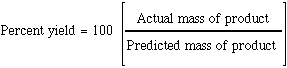
The percent yield is defined as


The predicted yield is determined by the masses used in a reaction and the mole ratios in the balanced equation. This predicted yield is the "ideal". It is not always possible to get this amount of product. Reactions are not always simple. There often are competing reactions. For example, if you burn carbon in air you can get carbon dioxide and carbon monoxide formed. The two reactions occur simultaneously. 

Some carbon atoms end up in CO and others end up in CO2. The typical calculation in a starting class assumes that there is only one path for the reactants. This is an over simplification.You know for example from real life that food is not always converted to energy. If you eat a cookie, some of it could end up stored as "fat" Ugh!


Example:

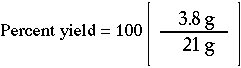
What is the percent yield for a reaction if you predicted the formation of 21. grams of C6H12 and actually recovered only 3.8 grams?

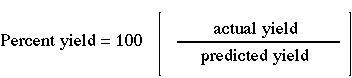
1. Recall definition of percent yield.


2. Substitute the actual and predicted 
yields.
 
3. Answer: The percent yield is 18 %.


Example 2:

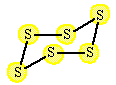
A reaction between solid sulfur and oxygen produces sulfur dioxide.
The reaction started with 384 grams of S6 (s). Assume an unlimited supply of oxygen. What is the predicted yield and the percent yield if only 680 grams of sulfur dioxide are produced? 


1 S6 (s) 6 O2 (g) 6 SO2 (g)
       

Step 1 : Calculate the molar masses for S6 (s) and SO2(g). The oxygen has no effect on the answer because there is more than you need.
1 mole S6 (s)= 193 grams S6 (s); 1 mole SO2(g) = 64 grams SO2(g)

Step 2 : Mole ration method
Determine the mole ratio for 1 mole S6 (s) to mole SO2(g)
The balanced equation indicates 1 mole S6 (s) to 6 mole SO2(g)

Step 3 : Calculate the number of moles of S6 (s)
moles S6 (s) = [384 g S6 (s)][ 1 mole S6 (s)/ 192 g S6 (s)] = 2 moles S6 (s)

Step 4 : Calculate the moles of SO2(g) expected using the mole ratio 6 moles SO2(g) / 1 mole S6 (s)
moles SO2(g) = 2 moles S6 (s)[6 SO2(g) / 1 S6 (s)] = 12 moles SO2(g)

Step 5 Calculate the grams of SO2(g) predicted using 1 mole SO2(g) = 64 grams SO2(g)
grams SO2(g) = 12 moles SO2(g)[64 grams SO2(g)/1 mole SO2(g)] = 768 g SO2(g)

Step 6 : Calculate the percent yield using the definition
Percent yield = 100[actual yield/ predicted yield] = 100[680 grams SO2(g)/ 768 g SO2(g)]= 89%

Saturday, March 26, 2011

Excess and Limiting Reactants!!


Limiting Reactant - The reactant in a chemical reaction that limits the amount of product that can be formed.  The reaction will stop when all of the limiting reactant is consumed.

Excess Reactant - The reactant in a chemical reaction that remains when a reaction stops when the limiting reactant is completely consumed.  The excess reactant remains because there is nothing with which it can react.


No matter how many tires there are, if there are only 8 car bodies, then only 8 cars can be made.  Likewise with chemistry, if there is only a certain amount of one reactant available for a reaction, the reaction must stop when that reactant is consumed whether or not the other reactant has been used up.


Example Limiting Reactant Calculation:
A 2.00 g sample of ammonia is mixed with 4.00 g of oxygen.  Which is the limiting reactant and how much excess reactant remains after the reaction has stopped?
First, we need to create a balanced equation for the reaction:


4 NH3(g) + 5 O2(g)4 NO(g) + 6 H2O(g)

Next we can use stoichiometry to calculate how much product is produced by each reactant.  NOTE:  It does not matter which product is chosen, but the same product must be used for both reactants so that the amounts can be compared.


The reactant that produces the lesser amount of product: in this case the oxygen. Next, to find the amount of excess reactant, we must calculate how much of the non-limiting reactant (oxygen) actually did react with the limiting reactant (ammonia).


We're not finished yet though.  1.70 g is the amount of ammonia that reacted, not what is left over.  To find the amount of excess reactant remaining, subtract the amount that reacted from the amount in the original sample.